
Introduction
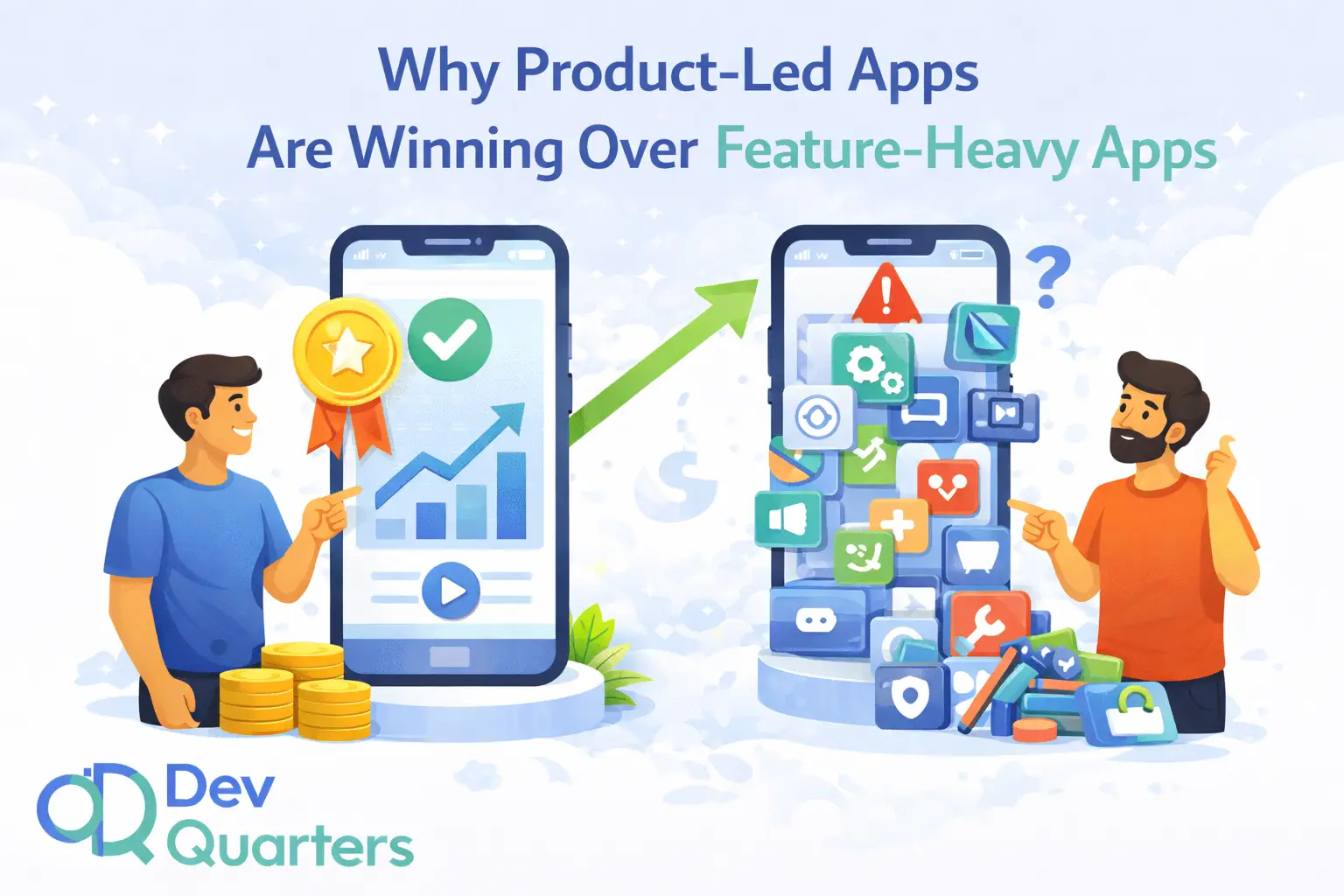
The mobile app market in 2026 looks nothing like it did a decade ago. Users download faster, decide quicker, and uninstall without hesitation. Retention—not downloads—has become the real growth metric. In this environment, more features no longer guarantee better performance. In fact, excessive functionality often overwhelms users instead of helping them. That’s why product-led app development is gaining momentum across industries. Rather than competing on feature volume, companies are competing on clarity, usability, and speed to value. Teams at Dev Quarters Innovation have observed that businesses embracing product-led app development consistently build stronger retention and long-term scalability without overcomplicating their products.
Why App Strategy Is Shifting in 2026
User behaviour has changed dramatically. Attention spans are shorter, alternatives are endless, and switching costs are nearly zero. If an app fails to deliver value within minutes—or even seconds—users move on.
The competition is also more intense. App stores are crowded, and discovery is only half the battle. Keeping users engaged is where most apps struggle. Complex interfaces, cluttered dashboards, and overloaded menus create friction that slows adoption.
Retention has replaced downloads as the primary success metric. Businesses now understand that sustainable growth comes from daily active users, not just installation spikes. This shift in thinking has accelerated the rise of product-led app development as a practical response to user expectations.
Product-Led App Development Explained
At its core, product-led app development focuses on delivering immediate, tangible value to users through the product itself. Instead of relying heavily on marketing promises or long feature lists, the app experience becomes the main growth driver.
Unlike traditional feature-driven roadmaps—where teams continually add new capabilities to compete—product-led app development prioritises outcomes. It asks:
- Does this feature solve a core user problem?
- Does it improve engagement?
- Does it increase retention?
If the answer is no, it does not make the roadmap.
This approach emphasises clarity, usability, and measurable value over quantity. Product-led app development aligns product decisions with real user behaviour data rather than internal assumptions.
Fewer Features, Faster Value
One defining trait of product-led growth apps is their ability to deliver value quickly. Time-to-value is critical. Users want to experience benefits almost immediately after onboarding.
Instead of overwhelming users with complex setup flows, product-led growth apps focus on:
- Clear onboarding steps
- Guided user journeys
- Immediate problem-solving
Solving one core problem extremely well often outperforms trying to solve ten moderately. Product-led app development encourages teams to refine a single value proposition until it becomes indispensable.
Faster value leads to higher activation rates and stronger word-of-mouth growth.
Why Feature-Heavy Apps Struggle to Retain Users
On the surface, feature-heavy apps may seem impressive. More dashboards, more tools, more customisation options. But in practice, feature-heavy apps often suffer from cognitive overload.
Users face:
- Too many choices
- Confusing navigation
- Steep learning curves
The result? Frustration and abandonment.
Beyond user experience, feature-heavy apps also create internal challenges. Increased maintenance costs, frequent bugs, and technical debt slow innovation. Each added feature requires testing, support, and updates.
Product-led app development avoids these pitfalls by maintaining focus. Instead of expanding endlessly, it refines purpose and usability.
User-Centric Design Over Feature Quantity
Strong user-centric app design sits at the heart of product-led app development. Rather than assuming what users want, teams collect feedback, analyse behaviour, and iterate continuously.
Key elements include:
- In-app surveys
- Usage analytics
- A/B testing
- Heatmap tracking
This feedback loop ensures decisions are based on real interaction patterns. User-centric app design does not eliminate features arbitrarily—it evaluates their impact.
When development revolves around user behaviour instead of internal brainstorming sessions, retention improves naturally.
Product-led app development thrives in environments where listening to users is systematic, not occasional.
UX as a Growth Driver, Not Just Design
A strong mobile app UX strategy is no longer just about visual polish. It directly influences activation, engagement, and habit formation.
Effective UX strategies focus on:
- Streamlined onboarding flows
- Friction reduction at every step
- Clear calls to action
- Intuitive navigation
When users feel confident navigating an app, they are more likely to return. Product-led app development integrates UX decisions into business strategy rather than treating design as a final layer.
Small improvements—such as simplifying sign-up processes or reducing form fields—can dramatically improve retention rates.
In 2026, UX is not decoration. It is a growth infrastructure.
How Modern App Teams Are Building Differently
Emerging modern app development trends reinforce the product-led philosophy. Instead of large, infrequent releases packed with new features, teams now favour smaller, incremental updates.
Analytics-led decision-making drives these updates. Teams measure:
- Feature adoption rates
- Drop-off points
- Session durations
- Retention cohorts
This data informs product direction in real time.
Continuous improvement replaces rigid annual roadmaps. Product-led app development aligns naturally with agile methodologies, encouraging experimentation and refinement.
Rather than chasing trends, modern teams validate every change against measurable user impact.
Common Mistakes When Trying to Build Product-Led Apps
While product-led app development offers clear advantages, misapplication can create new challenges.
Copying Without Context
Not every tactic used by successful product-led growth apps will fit another audience. Blind imitation leads to misalignment.
Removing Features Without Clarity
Simplicity is powerful, but arbitrary feature removal can alienate loyal users. Decisions must be data-driven.
Ignoring Retention Metrics
Product-led app development depends on tracking engagement, churn, and activation rates. Without measurement, strategy becomes guesswork.
True product-led thinking requires discipline and ongoing evaluation—not just minimalism.
Why the Product-Led Model Scales Better
Scalability depends on efficiency. Apps burdened by unnecessary features often struggle to scale due to maintenance complexity and support demands.
Product-led app development creates lean systems with clear value propositions. Leaner products are easier to maintain, update, and optimise.
When adoption is driven by product experience rather than heavy marketing spend, growth becomes more sustainable. Retention improves. Referrals increase. Customer acquisition costs decrease over time.
This shift reflects a broader industry realisation: usability beats excess.
Conclusion
The rise of product-led app development signals a broader change in how digital products succeed. Users prioritise clarity, speed, and meaningful outcomes over extensive feature lists. By focusing on immediate value, continuous feedback, and retention metrics, product-led app development improves adoption and long-term scalability.
At Dev Quarters Innovation, the pattern is clear—apps that prioritise user experience and measurable outcomes outperform those chasing feature expansion. As competition intensifies, the question is no longer how many features your app has, but how effectively it solves a real problem.
If you’re evaluating your next product roadmap, it may be time to reconsider whether adding more features is the answer—or whether refining your core experience could drive stronger results.